5 things AI sees in your morning P&L that you don't
AI reads the same daily P&L as five reports at once — cash, commissions, customers, GST, and menu.
5 things AI sees in your morning P&L that you don't
AI reads the same daily P&L as five reports at once — cash, commissions, customers, GST, and menu.
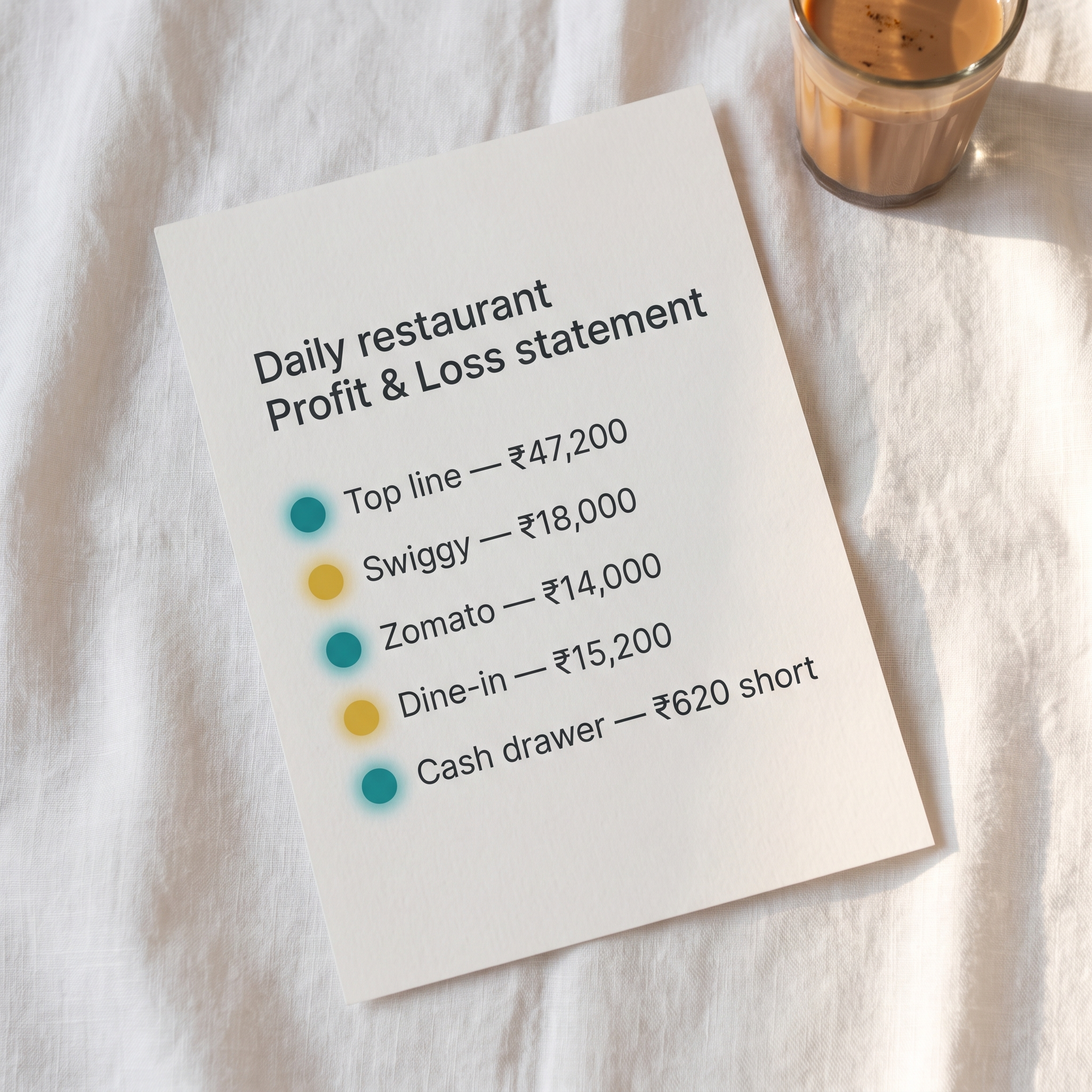
It's June 2026. 9:14am at a 38-seater family restaurant in Pune. The owner — call him Mahesh — is sipping cutting chai and scrolling yesterday's Petpooja day-end on his phone. Top line ₹47,200. Swiggy ₹18k. Zomato ₹14k. Dine-in ₹15.2k. Cash drawer ₹620 short. He sighs, marks the short as "Imran's shift again," and moves on to the supplier WhatsApps.
That single ₹620 isn't the story. The story is what an AI agent reading the exact same P&L would have flagged in the same 14 seconds — five things, in parallel, that no human reads a daily P&L looking for. Not because owners are missing the obvious, but because the obvious takes one set of eyes. The non-obvious takes five sets running simultaneously across yesterday's data, the last 8 days of shift patterns, the commission contract PDF, the 90-day customer list, and the compliance calendar. Humans can do any one. AI restaurant P&L analysis in India is starting to mean something specific: all five at once, every morning, before the chai is finished.
Here are the five.
1. The cash drawer variance pattern (not just today's ₹620 short)
A human looks at yesterday's drawer short and sees one number: ₹620. Annoying, mark it down, move on.
AI looks at the same ₹620 and runs a time-series check against the last 30 days of cash reconciliations. It notices this is the third short on Imran's evening shift in 8 days — ₹420, ₹510, ₹620 — and that no shorts at all appeared on the other two evening cashiers' shifts in the same window. It computes the rough probability that this is random variance (low) versus a pattern (high), then surfaces the question the owner wasn't going to ask: "Drawer ₹620 short — third short on Imran's evening shift in 8 days. Pull the shift-level pattern report?"
The owner still decides what to do. AI just makes sure the pattern doesn't go uninvestigated for another 8 shorts.
2. The aggregator commission bleed (the real take, not the headline rate)
Swiggy's settlement PDF says 26% commission. That's the headline number on page one. Most owners read page one.
AI reads page four. It nets out the packaging fee passback, the ads deduction, the customer compensation charge, the GST on commission, the PG fee — every line item that sits below the fold. Then it recomputes the effective commission against gross order value. Last week, on a ₹91,300 gross, the deductions stacked up to ₹28,300 — a real take of 31%, not 26%. The 5-point gap is ₹4,500 the owner thought they were keeping but weren't.
AI also cross-checks each deduction line against the actual commission contract. If "packaging adjustment" is contracted at ₹8 per order but billed at ₹22 per order across 200 orders, that's a ₹2,800 dispute waiting to be filed — with line-item proof, not vibes. Reported commission rates are marketing. Real take is math. AI does the math every settlement cycle.
3. The lapsed customer cohort hiding inside yesterday's covers
Yesterday's P&L shows 47 dine-in covers across 12 tables. A human reads "47 covers" and feels good about it.
AI reads "47 covers" and immediately asks the next question: who are the 47 who didn't come? It cross-references the UPI taps, the reservation names, and the loyalty taps from yesterday against the owned customer list of the last 12 months. Yesterday's 47 walked in. The system also flags the 47 from the same neighbourhood who used to come every 2-3 weeks and now haven't been back in 90 days — birthday bookings, high-AOV regulars, a few single visits that looked promising and then went cold.
That second 47 isn't yesterday's revenue. It's next Tuesday's revenue, if a winback message lands in the right voice tonight. The P&L is also a customer-attendance report — the system just has to be told to read it that way.
4. The compliance deadline clock ticking inside the filing date
Today's P&L date is June 5. That's not just a row in the ledger. It's also a position on a compliance calendar.
AI reads "June 5" and runs through the deadline list in 200 milliseconds: GSTR-3B due June 20, GSTR-2B auto-generates June 14 (so ITC reconciliation should start around June 12, not June 19), TDS deposit June 7, PF/ESI June 15. It checks the FSSAI renewal window — if the state licence expires in August, the 60-day renewal window opens this week. It checks state licence renewals (PPL music licence, pollution NOC, fire NOC) against their expiry dates.
The output isn't a calendar dump. It's a single line in the morning brief: "GSTR-3B due in 15 days, GSTR-2B drops in 9. Want me to start the ITC chase on the 4 supplier GSTINs from May that didn't appear in 2B last month?" No human reads a daily P&L as a compliance timer. AI reads everything as a compliance timer.
5. The low-margin, high-velocity item hiding under last night's chart
Last night, Chicken Lollipop was the second-highest-velocity dish — 24 orders. A human sees that and thinks: good, the starter is moving.
AI sees the same 24 orders and cross-references the dish against the 30-day margin matrix. Chicken Lollipop's food cost has crept up — chicken wings went from ₹220/kg to ₹260/kg over the last quarter, but the menu price still reads ₹240. Margin on the dish is 28% — well below the 40%+ on the rest of the starter section. High velocity, low margin: that's a thin-margin volume seller, not a high-margin best-seller. Every order is volume without proportional profit.
The same matrix-read also surfaces the inverse: a high-margin item with no velocity that deserves a feature placement, or a cluster of three similar dishes cannibalising each other's orders. The data was already there in yesterday's P&L. The pattern just needs five comparisons run at once, which is exactly the job humans don't have time for at 9am.
So what now
These five aren't occasional insights pulled out for a quarterly review. They're available every single morning from the same data the owner already has in Petpooja and the aggregator dashboards. The constraint isn't data. It's the parallel processing capacity to run five different pattern-recognition jobs simultaneously while also opening the restaurant for lunch service. AI has that capacity. Humans reading a P&L over chai do not.
For now, the lowest-effort version of AI restaurant margin analysis is: paste yesterday's day-end CSV and the last 7 days of settlement PDFs into Claude or ChatGPT every morning, and ask for these five reads explicitly. ChatGPT restaurant profitability work in India has gone from novelty to genuinely useful in the last six months — the models read Petpooja exports and Swiggy settlement PDFs cleanly now. It works. It takes about 12 minutes once you have the prompt saved. The friction is doing it every single day, before service, with the right files in hand.
If you'd rather have this whole AI morning briefing land in your WhatsApp at 9am — your unified P&L, your shift-level cash pattern, your real-take commission audit, your lapsed customer cohort, your compliance clock, and your low-margin volume sellers all in one message with three suggested actions — that's what SideKyk's restaurants team is built to do for Indian restaurant daily operations. We're not live for restaurants-India yet; we ship vertical by vertical. Drop your number at sidekyk.ai/restaurants and we'll WhatsApp you the morning your slot opens — usually within a week of the vertical going live.
Want this running in your WhatsApp every Monday morning?
Drop your number — we'll WhatsApp you the moment Restaurants goes live.
Join the waitlist on WhatsAppPowered by SideKyk · A team of AI agents in your WhatsApp